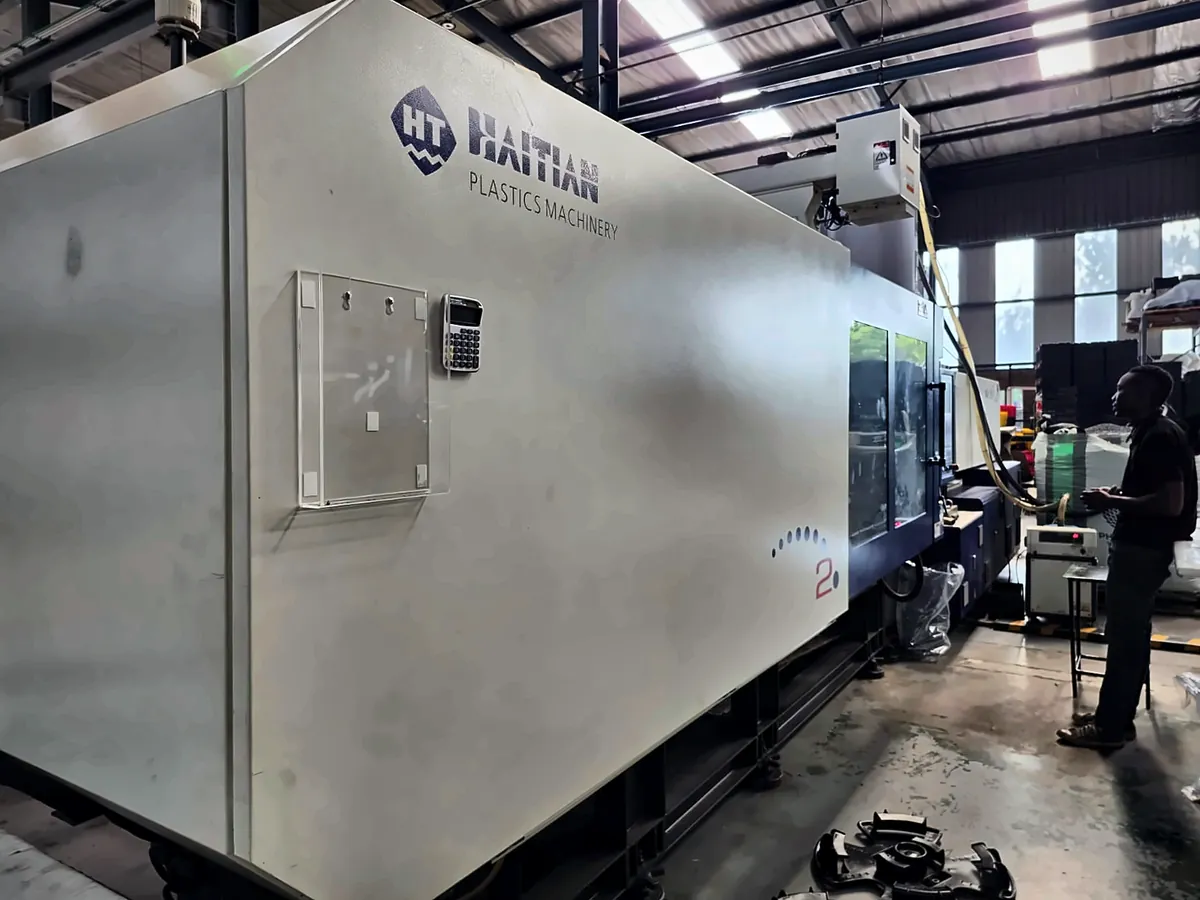
Injection moulding · Johannesburg
Custom plastic injection moulding, 80 to 1200 tonnes.
Production moulding of precision plastic parts and components for South African and international manufacturers — backed by more than four decades of experience with engineering thermoplastics and our own in-house toolroom.
- 80–1200 tonne machines
- Parts over 7 kg
- Engineering thermoplastics
- Local & export supply
Our moulding capability
Moulding capacity that scales with your product.
Injection moulding is the preferred manufacturing process when you need thousands — or millions — of the same plastic part. Plastic granules are heated to a molten state and injected under pressure into the cavity of a precision steel mould, where they cool into a finished part with consistent dimensions, finish and colour.
Our machine park runs from 80 tonnes to 1200 tonnes clamping force, so we can produce small, intricate components as well as large, heavy parts weighing more than 7 kg. That range lets us keep a growing product with the same moulder as volumes, sizes and product lines expand.
Because the toolroom that builds and maintains the moulds sits alongside the moulding floor, problems are solved quickly and production stays on schedule.
At a glance
Injection moulding capabilities
| Clamping force | 80 to 1200 tonnes |
|---|---|
| Part size & weight | Small precision components up to large parts weighing over 7 kg (7 000 g) |
| Production volumes | Short production runs through to large-capacity, high-volume runs |
| Materials | Nylon (PA6, PA66), polycarbonate (PC), PVC, Noryl (PPE), polypropylene (PP), polystyrene (PS/HIPS), styrenics, acrylic (PMMA) and other thermoplastics on request |
| Tooling | Injection moulds designed and built in our own toolroom; maintenance and repair of customers' moulds |
| Secondary operations | Assembly, testing, printing and packaging to customer specification |
| Markets | South Africa-wide supply and export / international projects |
| Location | 1 Tanjovan Street, Kya Sands, Johannesburg (Randburg), Gauteng |
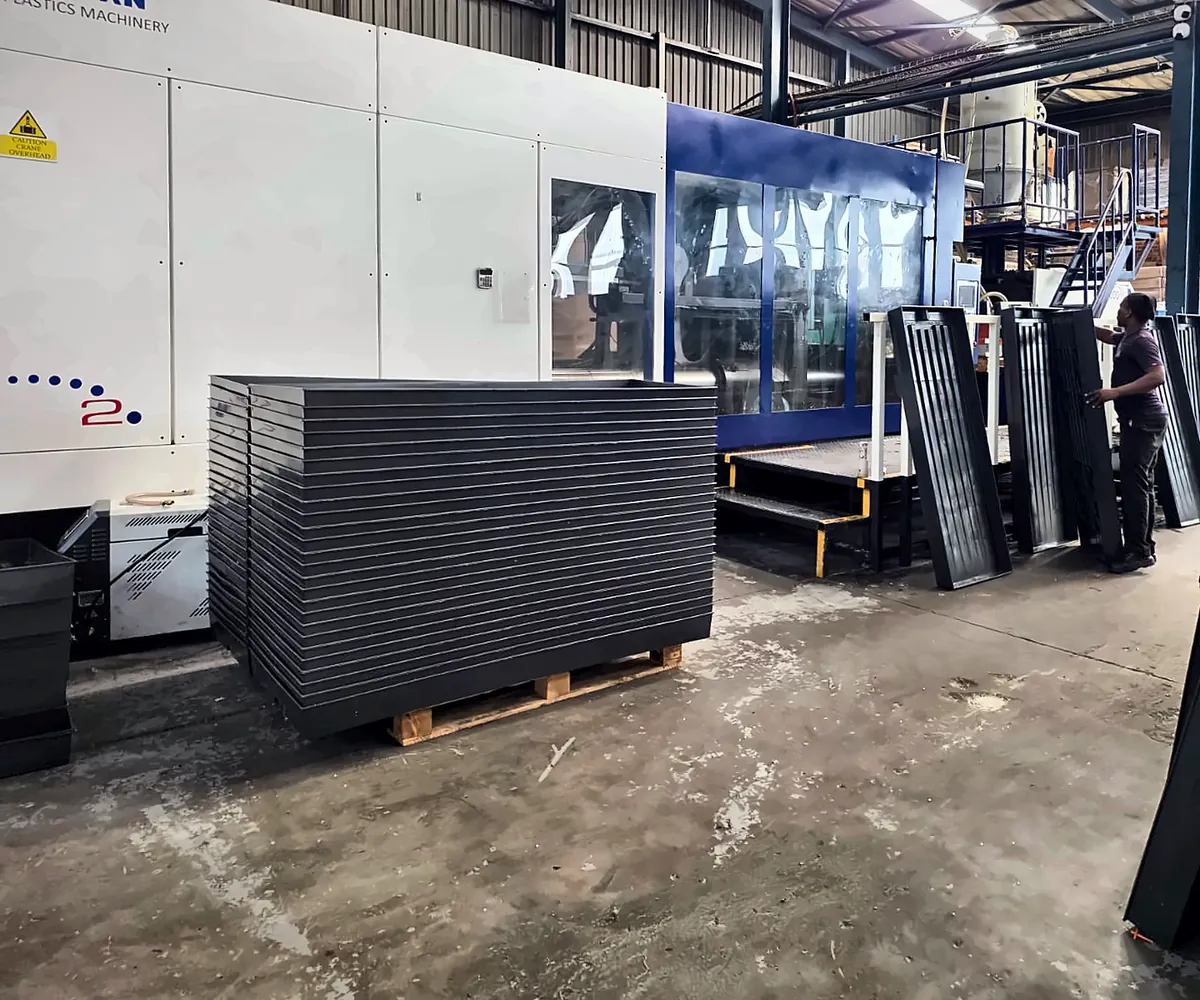
From machine to pallet
Every part is checked before it leaves the machine.
Our operators take parts straight from the mould, then trim, inspect and pack them at the machine, so problems are caught on the first part rather than the thousandth.
- First-off approval. Production only starts once you have signed off the samples.
- Checked at the machine. Operators finish and inspect parts as they are moulded.
- Packed to your spec. Counted, packed and palletised, ready for your line.
The moulding cycle
How your part is made
Every injection moulding cycle follows the same four stages. Getting each one right — temperature, pressure, speed and cooling time — is what separates a consistent, stress-free part from a reject.
- 1 · ClampThe two mould halves close under up to 1200 tonnes of force.
- 2 · InjectMolten plastic is shot through the nozzle into the cavity.
- 3 · CoolThe part solidifies while the screw meters the next shot.
- 4 · EjectThe mould opens and ejector pins release the finished part.
Material expertise
The right plastic makes the part.
Choosing the right type of plastic is often critical. Our advice is based on decades of moulding experience, so you get a material that meets the mechanical, thermal and cost requirements of your application. Materials guide
Nylon (PA)
Strong, wear-resistant engineering plastic for gears, clips, bushes and technical parts.
Polycarbonate
Clear, extremely impact-resistant — shields, covers, lighting and enclosures.
Noryl (PPE)
Dimensionally stable and water-resistant — ideal for pool, pump and water parts.
Polypropylene
Light, tough and chemical-resistant — crates, closures, housewares and more.
Why mould locally
A local moulder is a competitive advantage.
Imported parts can look cheaper on paper — until lead times, freight, exchange-rate swings and quality problems are added in.
- Shorter supply chains. Parts are made in Johannesburg and delivered by road, not by sea.
- Rand-based pricing. Less exposure to currency swings and international freight costs.
- Moulds you can visit. Your tooling is built and maintained where it runs, so changes and repairs are quick.
- Engineering support on your doorstep. Talk to the people actually making your parts.
2.06 Mt
Plastics consumed in South Africa in 2025, according to Plastics|SA — with rising imports cited as a key pressure on local converters.
±1 500
Plastics converters in South Africa, employing around 55 000 people (Plastics|SA annual report).
80%
Share of tools, dies and moulds used in South Africa that have historically been imported — the reason local toolmaking capability matters (dtic / industry estimates).
Who we mould for
Components for well-known South African products.
Electrical, lighting, swimming pool, water filtration, hospitality, furniture, building, electronic, automotive, housewares, scientific, closures and consumer products are just some of the sectors we supply.
Electrical
Enclosures, junction boxes, switch & socket parts
Lighting
Diffusers, lamp housings and fittings
Automotive
Interior, under-bonnet and accessory components
Water & Filtration
Water meter housings, filter and valve parts
Swimming Pool
Pool cleaner, pump and fitting components
Rigid Packaging
Dairy, frozen-food and produce crates
Closures & Cosmetics
Caps, closures and cosmetic packaging
Electronics & Security
Remote housings, device casings and covers
Building & Construction
Fixings, fittings and building components
Furniture & Hospitality
Furniture parts, glides and hospitality ware
Housewares
Buckets, bowls, hangers and containers
Scientific
Technical and laboratory components
How we work
A clear path from enquiry to production.
-
Consult & quote
Share a drawing, sample or idea. We discuss quantities, material, finish and budget, then quote the mould and part price.
-
Design & engineer
We refine the part for moulding — wall thickness, draft, gating — and design the mould in CAD.
-
Build the mould
Our toolmakers machine, spark-erode, fit and polish the mould in our own Johannesburg toolroom.
-
Sample & approve
First-off samples are moulded and checked against your specification. You sign off before production starts.
-
Produce & deliver
Production runs, assembly, printing and packing to your spec — delivered, with your mould maintained in-house.
FAQ
Injection moulding questions
What size injection moulding machines do you have?
Our injection moulding machines range from 80 tonnes to 1200 tonnes clamping force. That covers everything from small precision components to large parts weighing over 7 kg.
What quantities do you mould?
We run everything from short production runs to large-capacity, high-volume runs. Injection moulding becomes most cost-effective from a few thousand parts upwards because the mould is a once-off investment.
Can you mould using my existing mould?
Speak to us about your existing tooling. Our toolroom can assess the mould, carry out maintenance or repairs if needed, and our team will advise whether it suits our machines.
Which materials can you injection mould?
We regularly mould engineering and commodity thermoplastics including nylon (PA6, PA66), polycarbonate, PVC, Noryl, polypropylene, polystyrene, styrenics and acrylic. Our materials guide compares the most common options.
Do you offer assembly and packaging after moulding?
Yes. We assemble, test, print and pack moulded components to customer specifications — see assembly & packaging.
Do you supply export customers?
Yes. We are involved in international projects including rigid packaging and automotive components, and South African manufacturing rates make us competitive for overseas customers.
Ready to put your part into production?
Send us your drawings, quantities and material requirements — or call to talk it through with our team.